How this Muslim marriage app works: four calm steps to Nikah
No endless feed and no games. Just a clear path for people who are ready to marry.
1
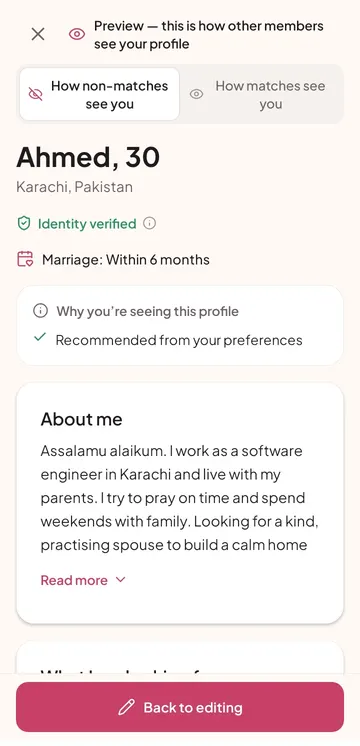
Create your profile
Share your deen, family, education and marriage plans, in your own words.
2
Pass a live check
A guided selfie (or, for sisters who wear niqab, a female-reviewed photo) shows you are a real person.
3
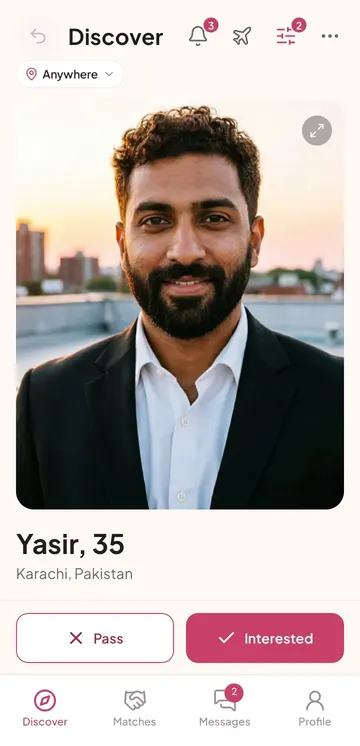
Discover with reasons
A curated daily set of people who fit your marriage goals, with plain reasons why you are seeing them.
4
Talk and involve family
Chat respectfully when you are both interested, then invite your wali or family when it feels right.
1Create your profile
2Live check
3Discover
4Show interest
M
5Chat
6Involve families
Step by stepIllustration with sample content.
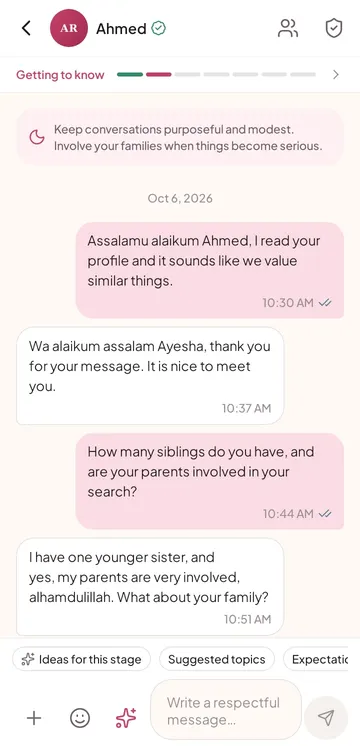
Respectful conversation
Conversations with adab
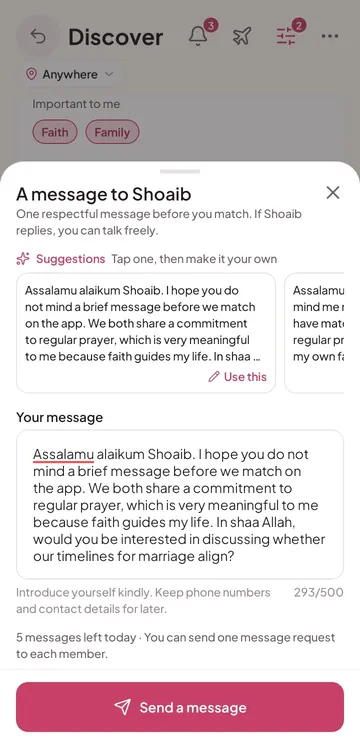
Start with one kind, respectful message. Phone numbers and contact details stay out of the conversation early on, until you both agree to share them, and gentle prompts keep it purposeful.
Report and Block on every profile and chat
Every report is reviewed by real moderators
Chats are checked for money and visa scams, with warnings for you
Real people should meet real people. These protections are on for every member, free.
Verification
Real people, checked live
A guided selfie with a random head-turn proves a real person is behind the profile, and is compared with their photos. Sisters who wear niqab can send a photo checked by a female reviewer instead. Members who add their ID carry an “Identity verified” badge.
Optional ID verification with your CNIC, Emirates ID, Iqama or passport
Your ID is never shown to members and is deleted after review
AI checks and human moderators look for fake and duplicate profiles
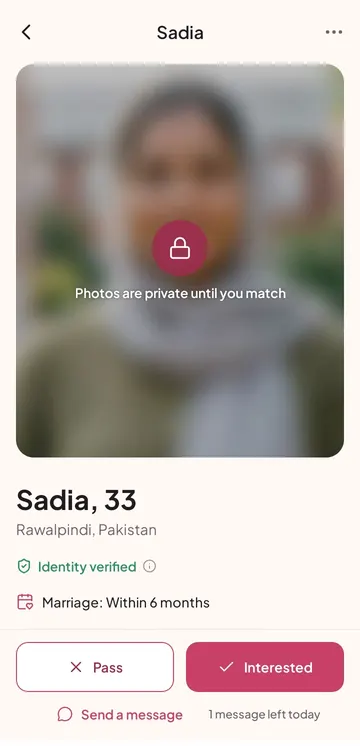
Photo privacy
You choose who sees your photos
Keep photos blurred until you both show interest or until you approve a request, or show them only to members you choose. Hijab, niqab, cap and kufi are always welcome.
Public, Private or Invisible profile modes
Avoid contacts: people in your phone book won’t see you
Nobody can search for you by phone number, email or ID
We never sell your data or use it for advertising. Carefully chosen service providers help us run Nikkup, including hosting and storage, identity checks, verification codes, email, notifications, payments, safety reviews and optional AI writing help. They are required by contract to protect your data and process it only as needed for their work. See the full list.
You’ve been talking for a while. When you’re both ready, involving your families is the next step.Involve familiesNot now
Illustration with sample content.
Families have always helped their children find a good rishta. Nikkup keeps that spirit for Muslims at home and abroad, with pages for Pakistan, India, Bangladesh, Saudi Arabia, the UAE, the UK, the USA, Canada, Malaysia and Indonesia. The app speaks English, Urdu and Arabic.
From the blog
Guides for the marriage journey
Practical, calm advice for Muslims and their families.
Each day we pick one question about nikah and married life that a qualified mufti has already answered, and summarise it in a few lines. Every summary links to the full answer at its source.
Someone asked which goods belong to a divorced woman and which to the husband, separating what her parents gave her as dowry from what her husband and his family gave. Mufti Muhammad Hashim Khan Attari answered that the dowry goods given by her parents belong to her alone, and nobody else has any right over them. For items given by the husband or his family he described three cases: if they clearly made her the owner it is hers, if they said it was only for temporary use the giver may take it back, and if nothing was said the custom of the husband's family decides. The respected mufti added that under that custom the woman keeps the items only if it is their practice to make the wife the owner, and otherwise they can be taken back.
Answered by Mufti Muhammad Hashim Khan Attari, Dar-ul-Ifta Ahl-e-Sunnat (Dawat-e-Islami)·Summarised on Nikkup
This is a brief summary for reference only. Read the full answer at the source, and consult a qualified scholar about your own situation. Scholars and schools of thought may differ on some questions. Nikkup does not issue fatwas.
Someone asked whether every sum or item written anywhere on a marriage contract form counts as mahr, and…
Answered by Mufti Muhammad Qasim Attari, Dar-ul-Ifta Ahl-e-Sunnat (Dawat-e-Islami)·Fatwa #FAM-1170·Summarised on Nikkup
This is a brief summary for reference only. Read the full answer at the source, and consult a qualified scholar about your own situation. Scholars and schools of thought may differ on some questions. Nikkup does not issue fatwas.
Common questions
What is Nikkup?
Nikkup is a nikah app: a Muslim marriage app for people who are serious about Nikah, made by Sowaan (Private) Limited in Karachi, Pakistan. It helps single, divorced and widowed Muslims find a spouse, with private photos, wali and family involvement, and free access for women.
Is Nikkup a dating app?
No. Nikkup is for Muslims who are seeking marriage. There is no casual swiping, no games, and every feature is designed to help you move toward Nikah with your family involved.
Is Nikkup free for women?
Yes. Women never pay a subscription on Nikkup: every core and Plus feature is included, from matching, chat and seeing who is interested to wali involvement and verification. Optional extras, like a second number for sharing in a contact exchange, are paid.
How does verification work?
You take a guided selfie with a short head-turn (sisters who wear niqab can instead send one photo in niqab, checked only by a female reviewer) and, if you choose, photograph an official ID (this is optional). We check that you are a real person, that your photos are you, and that you are 18 or over. Your ID is never shown to other members and is deleted after review.